

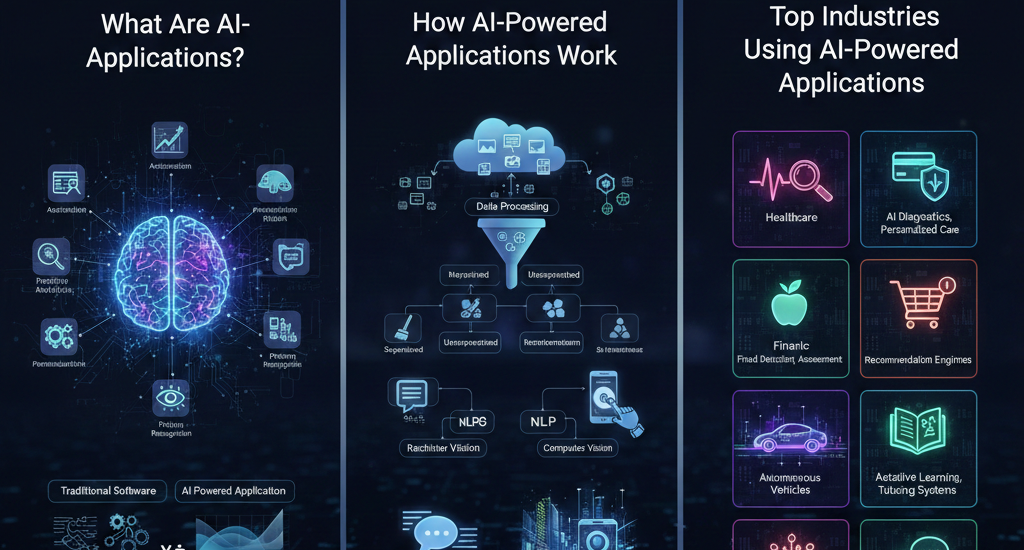
Artificial Intelligence (AI) is no longer a futuristic concept—it’s here, reshaping the way we live, work, and interact with technology. AI-powered applications are software programs that leverage AI technologies such as machine learning, natural language processing (NLP), and computer vision to perform tasks that traditionally required human intelligence. These applications can analyze vast amounts of data, recognize patterns, make predictions, and even learn from experience to improve their performance over time.
From personal assistants like Siri and Alexa to advanced healthcare diagnostic tools and business analytics platforms, AI-powered applications are becoming an integral part of modern life. They are not just tools—they are intelligent systems that enhance productivity, automate repetitive tasks, and provide actionable insights that help organizations make better decisions.http://aibygoogl.com
The rise of AI-powered applications is driven by several factors:
- Explosion of data: With billions of devices connected to the internet, AI systems have access to enormous amounts of structured and unstructured data.
- Advances in machine learning algorithms: Deep learning and reinforcement learning have enabled AI applications to perform tasks that were previously impossible for machines.
- Cloud computing and scalability: Modern AI applications rely on powerful cloud infrastructure to process and analyze data in real time.
- User demand for smarter solutions: Consumers and businesses alike expect apps to be personalized, responsive, and predictive, which AI technologies can deliver.
In this article, we’ll explore everything you need to know about AI-powered applications—from their core features and workings to industry applications, benefits, challenges, and future trends. Whether you are a business owner looking to implement AI solutions or a tech enthusiast curious about AI-driven software, this guide will provide comprehensive insights into the transformative power of AI applications.
What Are AI-Powered Applications?
Definition and Core Features
AI-powered applications are software programs designed to perform tasks that normally require human intelligence. Unlike traditional software, these applications can learn from data, adapt to new situations, and make decisions autonomously. By integrating technologies like machine learning, natural language processing (NLP), computer vision, and robotics, these applications can solve complex problems, automate processes, and provide personalized experiences to users.
Some core features of AI-powered applications include:
- Automation of repetitive tasks: AI apps can handle data entry, scheduling, email categorization, and other routine activities without human intervention.
- Predictive analytics: They can analyze historical data to forecast trends, detect anomalies, and provide actionable insights.
- Personalization: AI applications can tailor content, recommendations, or services based on user behavior and preferences.
- Pattern recognition: Using computer vision and machine learning, AI apps can identify images, speech patterns, and behaviors with high accuracy.
- Continuous improvement: AI applications “learn” over time, refining algorithms and responses as more data is processed.
For example, a streaming service like Netflix uses AI-powered applications to recommend movies and shows based on your viewing history. Similarly, AI-driven email filters sort spam and prioritize important messages automatically.
How AI-Powered Applications Differ from Traditional Software
Traditional software works by following pre-defined rules coded by developers. It performs exactly what it’s programmed to do but cannot adapt or learn from new data. In contrast, AI-powered applications are dynamic and capable of self-improvement.
Here’s a simple comparison:
| Feature | Traditional Software | AI-Powered Application |
|---|---|---|
| Learning | No | Yes, can learn from data |
| Adaptability | Low | High, adapts to new inputs |
| Decision Making | Rule-based | Data-driven, predictive |
| Personalization | Limited | Highly personalized |
| Pattern Recognition | Minimal | Advanced (images, speech, behavior) |
For instance, a traditional weather app shows forecasts based on historical patterns. An AI-powered weather application, however, can analyze real-time data, predict unusual events, and provide personalized alerts for a user’s location.
The ability of AI-powered applications to think, predict, and improve makes them a transformative force across industries, from healthcare to finance, education, and entertainment.
How AI-Powered Applications Work
Understanding how AI-powered applications work is key to appreciating their capabilities. These applications rely on several core technologies—data processing, machine learning, natural language processing (NLP), and computer vision—to make intelligent decisions, automate tasks, and provide insights.
Data Collection and Processing
Data is the foundation of all AI-powered applications. These apps require large volumes of data, both structured (like spreadsheets or databases) and unstructured (like text, images, audio, or video). The process generally involves:
- Data Acquisition: Gathering information from multiple sources such as sensors, user interactions, social media, or IoT devices.
- Data Cleaning and Preparation: Removing errors, duplicates, and irrelevant information to ensure high-quality input.
- Data Transformation: Converting raw data into formats suitable for machine learning models.
Example: In AI healthcare applications, patient medical records, lab results, and imaging data are collected and processed to help identify diseases earlier. Without high-quality data, AI applications cannot make accurate predictions or decisions.
Machine Learning and Deep Learning
At the core of most AI-powered applications is machine learning (ML), a subset of AI that allows software to learn from data without explicit programming. ML algorithms analyze historical data, detect patterns, and make predictions.
- Supervised Learning: The AI learns from labeled data. Example: Predicting if a loan application will be approved based on past applications.
- Unsupervised Learning: The AI identifies patterns without labeled data. Example: Customer segmentation in e-commerce.
- Reinforcement Learning: The AI learns by trial and error to achieve a goal. Example: Self-driving cars navigating traffic.
Deep learning, a type of machine learning, uses neural networks to analyze complex data like images, videos, and speech. This is essential for applications like facial recognition, voice assistants, and medical imaging analysis.
Natural Language Processing (NLP) in AI Applications
Natural Language Processing (NLP) enables AI-powered applications to understand, interpret, and respond to human language. NLP combines linguistics and machine learning to make interactions with software more natural.
Applications include:
- Virtual assistants: Siri, Google Assistant, and Alexa understand commands and answer questions.
- Chatbots for customer support: AI-driven chatbots handle inquiries 24/7, reducing workload for human agents.
- Text analysis: Sentiment analysis for social media monitoring, detecting positive or negative feedback.
Example: AI-powered translation apps like Google Translate use NLP to convert text or speech from one language to another in real time, improving communication across global audiences.
Computer Vision Applications
Computer vision allows AI-powered applications to analyze, interpret, and understand visual information from the world. By processing images and videos, these applications can perform tasks like object detection, facial recognition, and quality control.
Key uses include:
- Healthcare: Detecting tumors in radiology scans.
- Retail: AI-powered cameras track customer behavior and optimize store layouts.
- Security: Facial recognition for identity verification and surveillance.
- Autonomous vehicles: Real-time recognition of obstacles, road signs, and pedestrians.
Example: Tesla’s self-driving cars rely on computer vision to analyze their surroundings and make driving decisions safely.
Bringing It All Together
Most AI-powered applications combine multiple AI technologies to deliver smarter, more capable solutions. For example:
- A healthcare diagnostic app might combine computer vision (to read scans), machine learning (to predict disease), and NLP (to interpret patient reports).
- An AI-driven e-commerce platform might use machine learning for recommendations, NLP for customer support, and computer vision for visual search.
This synergy allows AI-powered applications to go beyond simple automation, providing intelligent decision-making, personalized experiences, and predictive insights that transform industries and everyday life.
Top Industries Using AI-Powered Applications
AI-powered applications are transforming nearly every industry by improving efficiency, enabling smarter decisions, and enhancing user experiences. Here’s a detailed look at how different sectors are leveraging these intelligent applications.
Healthcare
Healthcare is one of the fastest-growing adopters of AI-powered applications. These apps help diagnose diseases faster, personalize treatments, and optimize patient care.
Key examples include:
- AI diagnostics: Applications like IBM Watson Health analyze medical records, lab results, and clinical data to provide accurate diagnosis recommendations.
- Medical imaging: AI-powered computer vision systems can detect tumors, fractures, or anomalies in X-rays, MRIs, and CT scans.
- Predictive analytics: Apps predict patient deterioration, readmissions, and outbreak patterns.
Case Study: An AI-powered app developed by Google Health can detect breast cancer in mammograms with higher accuracy than human radiologists, reducing false positives and improving early detection rates.
Finance
The financial sector relies heavily on AI-powered applications for fraud detection, risk assessment, and investment decisions.
Applications include:
- Fraud detection: AI models analyze transactions in real time to flag suspicious activities.
- Algorithmic trading: AI-powered platforms execute trades automatically based on market patterns.
- Credit scoring: Machine learning algorithms assess loan applications more accurately than traditional methods.
Example: Mastercard uses AI-powered apps to monitor transactions for unusual patterns, preventing billions in potential fraud annually.
Retail and E-Commerce
AI-powered applications revolutionize retail by personalizing customer experiences, managing inventory, and optimizing operations.
Use cases include:
- Recommendation engines: Platforms like Amazon and Netflix use AI to suggest products or content based on browsing and purchase history.
- Chatbots: AI-driven chatbots provide 24/7 customer support.
- Inventory optimization: Predictive analytics ensures the right stock levels, reducing waste and shortages.
Fact: Retailers using AI-powered applications for personalized recommendations can see up to a 20% increase in sales.
Education
AI-powered applications are shaping the future of learning by providing personalized, adaptive, and efficient education experiences.
Applications include:
- Intelligent tutoring systems: Apps like Carnegie Learning adapt lessons to a student’s pace and understanding.
- Administrative automation: AI automates grading, attendance, and scheduling.
- Predictive analytics: Schools can identify students at risk of dropping out or underperforming.
Example: Duolingo uses AI-powered language learning algorithms to personalize exercises based on user performance.
Transportation
AI-powered applications are revolutionizing mobility, logistics, and autonomous driving.
Applications include:
- Self-driving vehicles: AI applications process sensor data in real time to navigate traffic safely.
- Traffic prediction: Apps optimize routes and reduce congestion using predictive algorithms.
- Fleet management: AI monitors vehicle performance, maintenance needs, and fuel efficiency.
Fact: According to McKinsey, autonomous vehicles powered by AI could reduce traffic accidents by up to 90%.
Marketing and Customer Service
Businesses use AI-powered applications to understand customer behavior, automate campaigns, and improve support.
Applications include:
- Predictive analytics: Forecasting trends and customer preferences.
- Chatbots and virtual assistants: Handling queries and guiding customers through processes.
- Content personalization: AI recommends products, emails, and ads tailored to individual users.
Example: Starbucks’ mobile app uses AI to suggest drinks based on past orders, time of day, and even local weather patterns.
Summary Table: AI-Powered Applications by Industry
| Industry | AI-Powered Application Examples | Benefits |
|---|---|---|
| Healthcare | AI diagnostics, predictive analytics, medical imaging | Faster diagnosis, personalized care |
| Finance | Fraud detection, algorithmic trading, credit scoring | Risk reduction, efficient decision-making |
| Retail & E-Commerce | Recommendation engines, chatbots, inventory management | Increased sales, optimized operations |
| Education | Adaptive learning apps, automated grading | Personalized learning, efficiency |
| Transportation | Autonomous vehicles, traffic prediction | Safety, cost savings |
| Marketing & Customer Service | Predictive analytics, virtual assistants | Better customer engagement, personalization |
Benefits of AI-Powered Applications
AI-powered applications are not just a technological trend—they provide tangible benefits that improve efficiency, reduce costs, and create better user experiences. From businesses to consumers, these intelligent applications are transforming workflows and decision-making processes across industries.
1. Efficiency and Productivity
One of the most significant advantages of AI-powered applications is their ability to automate repetitive tasks, freeing humans to focus on higher-value work. By handling time-consuming processes, AI apps reduce errors, save time, and increase operational efficiency.
Examples:
- AI-powered email management apps automatically sort and prioritize messages.
- Virtual assistants schedule meetings, set reminders, and manage daily workflows.
- Manufacturing robots, guided by AI applications, optimize production lines and reduce downtime.
Fact: According to Accenture, AI-powered automation could increase productivity by up to 40% in certain industries by 2035.
2. Personalization
AI-powered applications excel at analyzing user behavior and delivering personalized experiences. Whether it’s content recommendations, product suggestions, or learning paths, AI ensures that users receive relevant and customized interactions.
Examples:
- Netflix and Spotify recommend movies and music based on viewing and listening habits.
- E-commerce apps like Amazon suggest products tailored to individual users.
- AI-driven health apps provide personalized workout plans and diet recommendations.
Impact: Personalized AI experiences improve user engagement, retention, and satisfaction, making businesses more competitive.
3. Data-Driven Decision Making
AI-powered applications provide organizations with insights that are impossible to generate manually. By analyzing large datasets, AI apps detect patterns, predict trends, and offer actionable recommendations.
Examples:
- Retailers use AI analytics to optimize inventory and pricing strategies.
- Banks leverage AI applications to predict loan default risks and optimize credit offerings.
- Healthcare providers identify high-risk patients and design proactive interventions.
Quote: Sundar Pichai, CEO of Google, said: “AI is probably the most important thing humanity has ever worked on. It is more profound than electricity or fire.”
4. Cost Savings
AI-powered applications can significantly reduce operational costs by optimizing processes and reducing human intervention.
Examples:
- Chatbots reduce the need for large customer support teams.
- Predictive maintenance in manufacturing reduces equipment downtime and repair costs.
- AI-driven energy management applications optimize electricity usage in offices and factories.
Statistic: According to McKinsey, businesses using AI applications for process automation have achieved up to 20-30% reduction in operational costs.
5. Enhanced Accuracy and Reliability
AI-powered applications improve accuracy in tasks that require high precision. By minimizing human error and analyzing complex datasets, these apps deliver reliable results consistently.
Examples:
- AI diagnostic apps reduce misdiagnosis in healthcare.
- Financial AI applications detect fraudulent transactions that humans might miss.
- AI-based weather prediction apps provide more accurate forecasts than traditional methods.
Summary: Key Benefits of AI-Powered Applications
| Benefit | Description | Real-World Example |
|---|---|---|
| Efficiency & Productivity | Automates tasks, saves time, reduces errors | AI email management, robotic manufacturing |
| Personalization | Tailors experiences based on user behavior | Netflix, Amazon recommendations |
| Data-Driven Decisions | Provides actionable insights | Predictive analytics in finance & retail |
| Cost Savings | Reduces operational and labor costs | AI chatbots, predictive maintenance |
| Accuracy & Reliability | Delivers precise and consistent results | AI diagnostics, fraud detection |
Challenges and Limitations of AI-Powered Applications
While AI-powered applications offer incredible benefits, they are not without challenges and limitations. Understanding these issues is crucial for businesses and users to adopt AI responsibly and effectively.
1. Data Privacy and Security Concerns
AI-powered applications rely heavily on large volumes of data, including sensitive personal or business information. This makes them vulnerable to data breaches, misuse, or unauthorized access.
Challenges:
- Protecting customer and patient data from cyberattacks.
- Complying with regulations like GDPR, HIPAA, and CCPA.
- Ensuring that AI applications do not leak or misuse personal data.
Example: AI healthcare apps need to handle patient records securely, or they risk violating privacy laws and facing severe fines.
Solution: Implement strong encryption, secure cloud infrastructure, and strict access controls to safeguard data.
2. Bias and Ethical Issues
AI-powered applications can unintentionally reflect biases present in their training data. This may result in unfair or discriminatory outcomes.
Examples:
- Recruitment AI apps may favor certain demographics if trained on biased historical hiring data.
- Facial recognition systems have been found to have higher error rates for darker-skinned individuals.
Impact: Biased AI decisions can damage reputations, reduce trust, and lead to legal consequences.
Solution: Regularly audit AI models, use diverse datasets, and implement transparent and explainable AI frameworks.
3. High Development and Maintenance Costs
Developing and maintaining AI-powered applications can be expensive and resource-intensive.
Cost factors:
- Hiring skilled AI engineers and data scientists.
- Procuring high-quality datasets and cloud infrastructure.
- Continuous model training and software updates.
Example: Building a self-driving car AI application requires millions of dollars in R&D, testing, and safety validation.
Solution: Businesses can start with AI-powered SaaS platforms or APIs to reduce initial investment and scale gradually.
4. Dependence on Data Quality
The effectiveness of AI-powered applications directly depends on the quality of the data they are trained on. Poor-quality data leads to inaccurate predictions and unreliable results.
Examples of data issues:
- Incomplete or missing datasets
- Outdated or irrelevant information
- Noisy or inconsistent data
Impact: In healthcare, an AI diagnostic app using poor-quality data may misdiagnose patients, potentially endangering lives.
Solution: Implement rigorous data validation, cleaning, and preprocessing to ensure accuracy and reliability.
5. Complexity and Lack of Understanding
Many AI-powered applications are complex “black boxes”, making it difficult for users and even developers to understand how decisions are made.
Challenges:
- Lack of transparency can reduce user trust.
- Difficulty in debugging or improving models without clear insights.
Solution: Focus on explainable AI (XAI) frameworks that provide insight into model reasoning and outputs.
Summary Table: Key Challenges of AI-Powered Applications
| Challenge | Description | Possible Solution |
|---|---|---|
| Data Privacy & Security | Risk of breaches and misuse of sensitive data | Encryption, secure cloud storage, regulatory compliance |
| Bias & Ethical Issues | AI reflects biased training data | Diverse datasets, AI auditing, explainable AI |
| High Costs | Expensive development and maintenance | Use AI APIs, SaaS platforms, phased implementation |
| Data Quality Dependence | Poor data leads to poor predictions | Data cleaning, validation, preprocessing |
| Complexity & Transparency | Black-box decision-making reduces trust | Explainable AI, transparent models |
This section clearly explains the risks, limitations, and mitigation strategies of AI-powered applications, making readers aware of potential pitfalls while maintaining a practical, solution-oriented approach.
