
Introduction
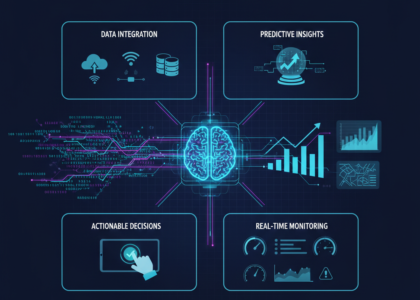
Artificial Intelligence has transformed the way businesses collect, process, and analyze data. In today’s digital economy, organizations generate massive amounts of information every second through websites, mobile apps, social media platforms, customer interactions, financial transactions, and operational systems. Traditional analytics methods often struggle to keep up with the speed and complexity of modern data. This is where AI analytics software becomes essential.
AI analytics software combines artificial intelligence technologies with advanced data analytics tools to help businesses uncover insights, predict trends, automate decision-making, and improve overall performance. From small startups to global enterprises, organizations across industries are using AI-powered analytics to gain competitive advantages and make smarter decisions.
This comprehensive guide explains what AI analytics software is, how it works, its key features, benefits, challenges, use cases, future trends, and much more.
Understanding AI Analytics Software
AI analytics software refers to platforms and tools that use artificial intelligence, machine learning, natural language processing, and automation technologies to analyze data and generate insights. Unlike traditional analytics systems that rely heavily on manual analysis and predefined rules, AI analytics systems can learn from data patterns, adapt over time, and provide intelligent recommendations.
The primary purpose of AI analytics software is to help organizations process large amounts of structured and unstructured data efficiently while identifying trends, anomalies, opportunities, and risks.
AI analytics software can:
- Analyze data in real time
- Predict future outcomes
- Detect unusual patterns
- Automate repetitive analytical tasks
- Provide intelligent recommendations
- Generate visual reports and dashboards
- Improve business decision-making
These tools are commonly used in marketing, healthcare, finance, retail, manufacturing, logistics, education, cybersecurity, and many other industries.
How AI Analytics Software Works
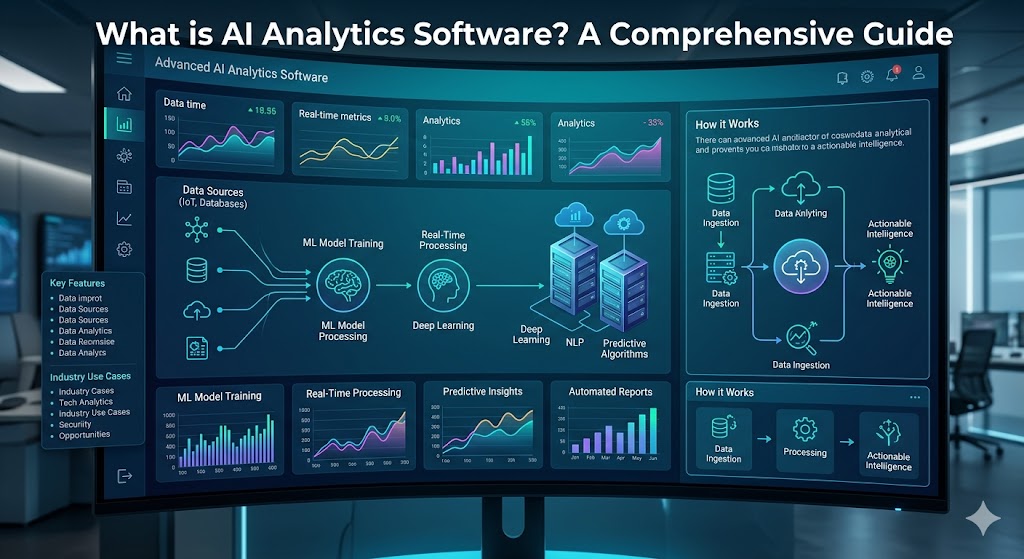
AI analytics software operates through a combination of technologies and processes. Understanding how these systems work can help organizations choose the right solution and maximize its benefits.
Data Collection
The first step involves collecting data from multiple sources such as:
- Databases
- Websites
- Cloud applications
- IoT devices
- CRM systems
- ERP systems
- Social media platforms
- Emails
- Sensors
- Financial systems
Modern AI analytics tools can integrate with numerous platforms to centralize data for analysis.
Data Cleaning and Preparation
Raw data is often incomplete, inconsistent, or duplicated. AI analytics systems automatically clean and prepare data by:
- Removing duplicates
- Filling missing values
- Standardizing formats
- Organizing datasets
- Identifying errors
Data preparation is critical because accurate insights depend on high-quality data.
Machine Learning Analysis
Machine learning algorithms analyze historical and real-time data to identify patterns and relationships. These algorithms improve over time as they process more data.
Common machine learning methods include:
- Regression analysis
- Classification
- Clustering
- Neural networks
- Decision trees
- Deep learning
Predictive Analytics
Predictive models use historical data to forecast future events. Businesses use predictive analytics for:
- Sales forecasting
- Customer behavior prediction
- Risk assessment
- Fraud detection
- Demand forecasting
- Inventory planning
Natural Language Processing
Natural language processing enables AI systems to understand human language. This allows users to interact with analytics platforms through conversational queries.
For example, users can ask:
- “What were last month’s sales trends?”
- “Which marketing campaign performed best?”
- “Why did customer churn increase?”
The software interprets the query and generates relevant insights.
Data Visualization
AI analytics tools present findings through visual dashboards, charts, graphs, and reports. Visualization helps decision-makers quickly understand trends and performance metrics.
Automated Recommendations
Advanced AI analytics software can recommend actions based on insights. For example:
- Suggesting marketing strategies
- Identifying operational improvements
- Recommending pricing adjustments
- Highlighting cybersecurity threats
Key Features of AI Analytics Software
Different AI analytics platforms offer various capabilities, but the most effective solutions generally include the following features.
Real-Time Analytics
Real-time analytics processes data instantly as it is generated. This helps businesses react quickly to changing conditions.
Predictive Modeling
Predictive modeling forecasts future outcomes using historical data patterns.
Automated Reporting
AI software automatically creates reports and dashboards, reducing manual workload.
Natural Language Queries
Users can ask questions in plain language instead of writing complex code.
Data Integration
AI analytics tools connect with multiple data sources for centralized analysis.
Anomaly Detection
The software identifies unusual behavior or suspicious activities automatically.
Sentiment Analysis
Businesses can analyze customer opinions from reviews, social media posts, and surveys.
Intelligent Alerts
Users receive notifications when critical metrics change significantly.
Self-Service Analytics
Non-technical users can access insights without requiring extensive technical knowledge.
Scalability
Modern platforms can handle growing amounts of data efficiently.
Types of AI Analytics Software
AI analytics solutions come in various forms depending on business needs and industry requirements.
Business Intelligence Platforms
These platforms combine traditional BI capabilities with AI-powered insights.
Examples include:
- Tableau
- Power BI
- Qlik
Predictive Analytics Software
These tools specialize in forecasting future trends and outcomes.
Customer Analytics Platforms
Customer analytics tools focus on understanding customer behavior and improving engagement.
Marketing Analytics Software
Marketing analytics tools optimize advertising campaigns, audience targeting, and customer acquisition.
Financial Analytics Software
Financial institutions use AI analytics for fraud detection, risk analysis, and investment forecasting.
Healthcare Analytics Platforms
Healthcare providers use AI analytics for patient monitoring, disease prediction, and operational efficiency.
Supply Chain Analytics Software
These tools optimize logistics, inventory management, and demand forecasting.
Cybersecurity Analytics Platforms
Cybersecurity tools use AI to identify threats and suspicious activities in real time.
Benefits of AI Analytics Software
AI analytics software provides numerous advantages for businesses of all sizes.
Faster Decision-Making
AI systems process massive datasets quickly, enabling organizations to make timely decisions.
Improved Accuracy
AI reduces human errors and provides more accurate insights.
Better Customer Experience
Businesses can personalize customer interactions using AI-driven insights.
Cost Reduction
Automation reduces manual labor and operational costs.
Increased Productivity
Employees spend less time analyzing data manually.
Competitive Advantage
Organizations gain valuable insights that help them outperform competitors.
Enhanced Forecasting
Predictive analytics improves planning and resource allocation.
Fraud Detection
AI systems identify suspicious activities faster than traditional methods.
Real-Time Monitoring
Businesses can monitor operations continuously and respond immediately to issues.
Scalability
AI analytics systems can handle increasing volumes of data efficiently.
Industries Using AI Analytics Software
AI analytics software is transforming nearly every industry.
Healthcare
Healthcare organizations use AI analytics to:
- Predict patient outcomes
- Detect diseases early
- Optimize hospital operations
- Personalize treatment plans
- Reduce healthcare costs
AI-powered analytics can analyze medical records, imaging data, and patient histories to improve healthcare delivery.
Finance
Financial institutions use AI analytics for:
- Fraud detection
- Credit scoring
- Investment analysis
- Risk management
- Customer segmentation
Banks and fintech companies rely heavily on AI to improve security and customer experiences.
Retail
Retail businesses use AI analytics to:
- Forecast demand
- Optimize pricing
- Personalize recommendations
- Improve inventory management
- Analyze customer behavior
E-commerce companies especially benefit from AI-powered recommendation systems.
Manufacturing
Manufacturers use AI analytics for:
- Predictive maintenance
- Quality control
- Production optimization
- Supply chain management
- Equipment monitoring
Marketing
Marketing teams use AI analytics to:
- Analyze campaign performance
- Segment audiences
- Predict customer behavior
- Improve advertising strategies
- Measure ROI
Education
Educational institutions use AI analytics for:
- Student performance tracking
- Personalized learning
- Enrollment forecasting
- Resource management
Transportation and Logistics
Logistics companies use AI analytics to:
- Optimize routes
- Predict delivery times
- Manage fleets
- Reduce fuel consumption
Telecommunications
Telecom companies use AI analytics to:
- Improve network performance
- Predict outages
- Reduce customer churn
- Enhance customer support
Components of AI Analytics Software
Understanding the main components of AI analytics systems helps organizations evaluate different platforms effectively.
Data Warehouse
A centralized repository stores large volumes of data.
Data Processing Engine
This engine transforms raw data into usable information.
Machine Learning Models
Algorithms analyze data patterns and generate predictions.
Visualization Layer
Dashboards and reports present insights visually.
API Integrations
APIs connect the software with external systems and applications.
Security Framework
Security features protect sensitive business data.
AI Analytics vs Traditional Analytics
Traditional analytics mainly focuses on historical reporting and descriptive analysis. AI analytics goes further by enabling predictive and prescriptive insights.
Traditional Analytics
- Relies heavily on manual analysis
- Uses predefined queries
- Focuses on historical data
- Limited automation
- Slower decision-making
AI Analytics
- Learns from data automatically
- Provides predictive insights
- Uses automation extensively
- Processes large datasets quickly
- Supports real-time decision-making
Challenges of AI Analytics Software
Despite its advantages, AI analytics software also presents several challenges.
Data Privacy Concerns
Organizations must ensure compliance with privacy regulations.
High Implementation Costs
Advanced AI systems may require significant investment.
Data Quality Issues
Poor data quality can reduce the accuracy of insights.
Integration Complexity
Connecting AI tools with existing systems can be challenging.
Skill Gaps
Organizations may need skilled professionals to manage AI systems.
Bias in AI Models
AI models can produce biased results if trained on biased data.
Security Risks
Sensitive business data must be protected against cyber threats.
Popular AI Analytics Software Platforms
Several leading platforms dominate the AI analytics market.
Microsoft Power BI
Power BI offers AI-powered visualization and business intelligence features.
Tableau
Tableau provides advanced analytics and interactive dashboards.
Google Looker
Looker helps businesses analyze and visualize data effectively.
IBM Watson Analytics
IBM Watson uses AI technologies for advanced business insights.
SAS Analytics
SAS provides powerful predictive analytics capabilities.
Qlik Sense
Qlik Sense supports AI-assisted analytics and reporting.
SAP Analytics Cloud
SAP combines analytics, planning, and AI features.
The Role of Machine Learning in AI Analytics
Machine learning is the foundation of most AI analytics systems.
Machine learning algorithms identify patterns in data without being explicitly programmed for every scenario.
Supervised Learning
Supervised learning uses labeled data to make predictions.
Unsupervised Learning
Unsupervised learning identifies hidden patterns in unlabeled data.
Reinforcement Learning
Reinforcement learning improves performance through continuous feedback.
Deep Learning
Deep learning uses neural networks to process complex datasets.
Predictive Analytics Explained
Predictive analytics is one of the most valuable capabilities of AI analytics software.
Organizations use predictive analytics to:
- Forecast sales
- Predict customer churn
- Identify risks
- Estimate demand
- Detect fraud
- Optimize operations
Predictive models continuously improve as new data becomes available.
Prescriptive Analytics
Prescriptive analytics goes beyond prediction by recommending actions.
For example:
- Recommending optimal inventory levels
- Suggesting marketing campaigns
- Identifying the best pricing strategy
This capability helps organizations make proactive decisions.
Real-Time Analytics and AI
Real-time analytics allows businesses to process and analyze data instantly.
Examples include:
- Fraud detection during transactions
- Monitoring website traffic
- Tracking manufacturing equipment
- Managing logistics operations
AI enhances real-time analytics by automating responses and recommendations.
Data Visualization in AI Analytics
Visualization is essential for understanding complex data.
Common visualization tools include:
- Dashboards
- Heat maps
- Pie charts
- Line graphs
- Scatter plots
- Interactive reports
Good visualization improves communication and decision-making.
Natural Language Processing in Analytics
Natural language processing enables AI systems to understand and interpret human language.
Applications include:
- Chatbots
- Voice assistants
- Sentiment analysis
- Text analytics
- Conversational analytics
NLP makes analytics more accessible for non-technical users.
AI Analytics for Small Businesses
Small businesses can benefit greatly from AI analytics software.
Advantages include:
- Affordable cloud-based tools
- Better customer insights
- Improved marketing performance
- Enhanced financial planning
- Increased efficiency
Cloud-based AI solutions have made advanced analytics accessible to smaller organizations.
Cloud-Based AI Analytics Software
Cloud computing has accelerated the growth of AI analytics.
Benefits of cloud-based solutions include:
- Lower infrastructure costs
- Easy scalability
- Remote access
- Faster deployment
- Automatic updates
Popular cloud providers include:
- Amazon Web Services
- Microsoft Azure
- Google Cloud Platform
AI Analytics and Big Data
Big data refers to extremely large datasets that traditional systems struggle to process.
AI analytics software helps organizations manage big data by:
- Processing large volumes quickly
- Identifying hidden patterns
- Automating analysis
- Supporting real-time insights
The combination of AI and big data is driving digital transformation across industries.
AI Analytics in Customer Experience
Customer experience has become a major competitive differentiator.
AI analytics improves customer experience by:
- Personalizing recommendations
- Predicting customer needs
- Analyzing feedback
- Reducing response times
- Improving support services
Businesses that understand customer behavior can build stronger relationships and increase loyalty.
AI Analytics in Human Resources
HR departments use AI analytics for:
- Recruitment optimization
- Employee performance analysis
- Workforce planning
- Retention prediction
- Training recommendations
AI-powered HR analytics helps organizations manage talent more effectively.
Ethical Considerations in AI Analytics
Ethics play an important role in AI analytics implementation.
Organizations must address concerns such as:
- Data privacy
- Algorithmic bias
- Transparency
- Accountability
- Responsible AI usage
Ethical AI practices build trust among customers and stakeholders.
Future Trends in AI Analytics Software
AI analytics technology continues to evolve rapidly.
Augmented Analytics
AI will increasingly automate data preparation, analysis, and visualization.
Explainable AI
Organizations demand more transparency in AI decision-making.
Edge Analytics
Data analysis will occur closer to where data is generated.
AI-Powered Automation
Automation will expand across business processes.
Hyper-Personalization
Businesses will deliver highly personalized customer experiences.
Conversational Analytics
Users will interact with analytics platforms using natural language.
Advanced Cybersecurity Analytics
AI will strengthen cybersecurity defenses against evolving threats.
How to Choose the Right AI Analytics Software
Selecting the right platform requires careful evaluation.
Define Business Goals
Identify what problems the software should solve.
Evaluate Features
Compare capabilities such as predictive analytics, visualization, and automation.
Consider Scalability
Choose software that can grow with your business.
Check Integration Options
Ensure compatibility with existing systems.
Assess Security Features
Protecting sensitive data is essential.
Review Pricing
Consider licensing, implementation, and maintenance costs.
Evaluate User Experience
The platform should be easy to use for technical and non-technical users.
Analyze Vendor Support
Reliable customer support and training are important.
Best Practices for Implementing AI Analytics Software
Successful implementation requires proper planning.
Start with Clear Objectives
Define measurable goals before deployment.
Ensure Data Quality
Clean and accurate data improves results.
Train Employees
Provide training to maximize adoption.
Monitor Performance
Continuously evaluate system effectiveness.
Maintain Security Standards
Implement strong cybersecurity measures.
Use Ethical AI Practices
Ensure fairness and transparency.
Common Use Cases of AI Analytics Software
Fraud Detection
Banks use AI to identify suspicious transactions instantly.
Recommendation Engines
Streaming and e-commerce platforms recommend products and content.
Predictive Maintenance
Manufacturers predict equipment failures before they occur.
Customer Churn Prediction
Businesses identify customers likely to leave.
Demand Forecasting
Retailers predict future product demand.
Dynamic Pricing
Companies adjust prices based on market conditions.
AI Analytics and Automation
Automation is a key component of AI analytics.
Automated processes include:
- Report generation
- Data cleaning
- Workflow management
- Customer segmentation
- Alert notifications
Automation improves efficiency and reduces operational costs.
The Importance of Data Governance
Data governance ensures proper management of business data.
Key aspects include:
- Data accuracy
- Security
- Compliance
- Accessibility
- Consistency
Strong governance improves the effectiveness of AI analytics systems.
AI Analytics for Startups
Startups can leverage AI analytics to compete with larger companies.
Benefits include:
- Faster decision-making
- Market insights
- Customer acquisition optimization
- Operational efficiency
- Better resource allocation
Cloud-based analytics tools make advanced capabilities affordable for startups.
AI Analytics in E-Commerce
E-commerce businesses rely heavily on AI analytics.
Applications include:
- Personalized product recommendations
- Customer behavior analysis
- Inventory management
- Dynamic pricing
- Fraud prevention
AI-driven insights help online retailers increase sales and improve customer satisfaction.
AI Analytics in Social Media
Social media analytics tools use AI to:
- Analyze engagement
- Track brand sentiment
- Identify trends
- Monitor competitors
- Optimize content strategies
Social media data provides valuable customer insights.
AI Analytics in Healthcare Diagnostics
Healthcare diagnostics have improved significantly with AI analytics.
AI systems can:
- Analyze medical images
- Detect diseases early
- Predict patient risks
- Assist doctors in diagnosis
These capabilities improve patient outcomes and reduce healthcare costs.
AI Analytics in Banking
Banks use AI analytics for:
- Fraud detection
- Customer segmentation
- Loan approval analysis
- Financial forecasting
- Risk management
AI helps financial institutions improve efficiency and security.
AI Analytics and Cybersecurity
Cybersecurity threats are becoming more sophisticated.
AI analytics strengthens security by:
- Detecting anomalies
- Monitoring network traffic
- Predicting attacks
- Automating threat responses
AI-powered cybersecurity tools help organizations respond quickly to threats.
The Impact of AI Analytics on Decision-Making
AI analytics enables data-driven decision-making.
Benefits include:
- Reduced uncertainty
- Faster responses
- Better forecasting
- Increased accuracy
- Strategic insights
Organizations that rely on data-driven strategies often achieve better business outcomes.
AI Analytics and Digital Transformation
Digital transformation initiatives often depend on AI analytics.
AI helps organizations:
- Modernize operations
- Improve customer experiences
- Increase efficiency
- Drive innovation
AI analytics is becoming a core component of digital business strategies.
Building an AI Analytics Strategy
Organizations should develop a structured strategy for AI analytics adoption.
Identify Key Objectives
Define business priorities and measurable outcomes.
Assess Current Infrastructure
Evaluate existing systems and data sources.
Choose Appropriate Tools
Select platforms aligned with organizational needs.
Establish Governance Policies
Implement data management and security standards.
Monitor and Improve
Continuously optimize AI models and analytics processes.
Measuring ROI of AI Analytics Software
Organizations should evaluate the return on investment from AI analytics.
Metrics may include:
- Revenue growth
- Cost reduction
- Productivity improvement
- Customer satisfaction
- Operational efficiency
Measuring ROI helps justify analytics investments.
Limitations of AI Analytics Software
Although powerful, AI analytics software has limitations.
Dependence on Data Quality
Poor-quality data reduces accuracy.
Complexity
Advanced systems may require technical expertise.
Cost
Enterprise-level platforms can be expensive.
Privacy Risks
Sensitive data must be protected carefully.
Over-Reliance on Automation
Human oversight remains important.
Conclusion
AI analytics software is revolutionizing the way organizations analyze data and make decisions. By combining artificial intelligence, machine learning, automation, and advanced analytics, these tools help businesses uncover valuable insights, improve efficiency, reduce costs, and gain competitive advantages.
From predictive forecasting and fraud detection to customer personalization and operational optimization, AI analytics software has become an essential technology across industries. As data continues to grow exponentially, organizations that embrace AI-driven analytics will be better positioned to succeed in the digital economy.
The future of AI analytics promises even greater automation, personalization, and intelligence. Businesses that invest in the right tools, strategies, and ethical practices can unlock significant value and drive long-term growth.
FAQs
What is AI analytics software?
AI analytics software is a platform that uses artificial intelligence and machine learning technologies to analyze data, generate insights, automate reporting, and support decision-making.
How does AI analytics software work?
It collects data from multiple sources, cleans and processes the data, applies machine learning algorithms, and generates insights through reports and visualizations.
What are the benefits of AI analytics software?
Benefits include faster decision-making, improved accuracy, automation, predictive insights, better customer experiences, and reduced operational costs.
Which industries use AI analytics software?
Industries such as healthcare, finance, retail, manufacturing, marketing, education, logistics, and telecommunications use AI analytics extensively.
What is predictive analytics?
Predictive analytics uses historical data and machine learning algorithms to forecast future outcomes and trends.
Is AI analytics software expensive?
Costs vary depending on the platform, features, and organization size. Many cloud-based solutions are affordable for small businesses.
What is the difference between AI analytics and traditional analytics?
Traditional analytics mainly focuses on historical reporting, while AI analytics provides predictive and automated insights using machine learning.
Can small businesses use AI analytics software?
Yes, many cloud-based AI analytics tools are designed specifically for small and medium-sized businesses.
What are the challenges of AI analytics software?
Common challenges include data privacy concerns, integration complexity, implementation costs, skill gaps, and data quality issues.
What role does machine learning play in AI analytics?
Machine learning helps AI systems identify patterns, make predictions, and improve performance over time.
What is real-time analytics?
Real-time analytics processes and analyzes data instantly as it is generated.
Why is data quality important in AI analytics?
Accurate and clean data is essential for generating reliable insights and predictions.
What are some popular AI analytics platforms?
Popular platforms include Microsoft Power BI, Tableau, Google Looker, IBM Watson Analytics, Qlik Sense, and SAS Analytics.
How does AI analytics improve customer experience?
It enables personalized recommendations, faster support, customer behavior analysis, and improved engagement.
What is augmented analytics?
Augmented analytics uses AI to automate data preparation, analysis, and insight generation.
Is AI analytics secure?
Most platforms include security features, but organizations must implement proper cybersecurity and data governance measures.
What is natural language processing in analytics?
Natural language processing enables users to interact with analytics systems using conversational language.
How does AI analytics help in fraud detection?
AI systems analyze transaction patterns and identify suspicious activities in real time.
What is prescriptive analytics?
Prescriptive analytics recommends actions based on predictive insights and data analysis.
What is the future of AI analytics software?
The future includes greater automation, explainable AI, conversational analytics, edge computing, and hyper-personalized experiences.