

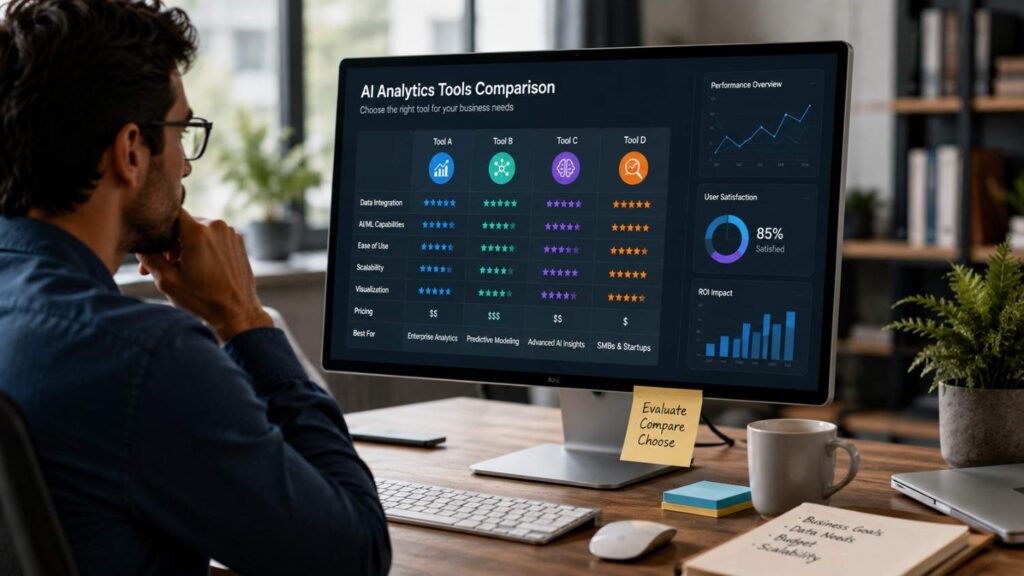
How to Choose the Right AI Analytics Tool for Your Business
Learning how to choose the right AI analytics tool for your business requires more than comparing product pages. Most platforms now promote natural-language questions, automated insights, anomaly detection, forecasting, or generated explanations, yet those capabilities can differ significantly in quality and practical usefulness. The right choice is not automatically the product with the longest feature list. It is the platform that fits your business problem, data environment, users, governance standards, operating model, and budget.
A strong selection process works backward from a decision. Start by asking what an employee should understand, decide, or do differently after receiving an insight. Then identify the data required, the people involved, the acceptable level of risk, and the metric that will show improvement. This approach keeps the evaluation grounded in business value and prevents an impressive AI analytics demo from becoming unused software.
The following framework explains how to define requirements, compare platform categories, test accuracy, assess integration and security, calculate total cost, and run a meaningful proof of concept. It is designed for small and mid-sized organizations, but the same principles also help larger teams create a disciplined procurement process. Beginners can use it as a step-by-step buyer’s guide, while experienced analytics and IT leaders can adapt the criteria to formal architecture, governance, and vendor-management standards.
Understand What an AI Analytics Tool Should Actually Do
An AI analytics tool uses artificial intelligence, machine learning, statistical techniques, or generative interfaces to help people examine business data and make better decisions. Depending on the product, it may answer questions in natural language, identify unusual changes, forecast future outcomes, explain likely drivers, recommend actions, or automate parts of report creation. However, vendors often use similar language for products with very different technical depth. Buyers should therefore translate broad claims into specific tasks that can be demonstrated and measured.
The foundation remains conventional analytics. The platform must connect to trusted data, apply calculations correctly, preserve business definitions, and present information in a form users can interpret. Artificial intelligence does not remove the need for accurate source systems, governed metrics, thoughtful visualization, or human judgment. Instead, it can reduce the effort required to explore data, surface patterns that might otherwise be missed, and make analytical capabilities accessible to more employees.
It is also important to understand where the product fits in your technology environment. Some AI analytics tools are complete business intelligence platforms, while others add specialized forecasting, conversational analytics, embedded insights, or decision intelligence to an existing stack. Clarifying the category helps you avoid comparing products that solve fundamentally different problems. Once the expected job is clear, feature evaluation becomes more disciplined, demonstrations become easier to test, and the shortlist becomes more relevant to the people who will actually use the system. That clarity also helps buyers distinguish essential analytics functions from optional enhancements that can be evaluated later.
Distinguish reporting from AI-assisted analysis
Traditional reporting organizes known information into dashboards, scorecards, and scheduled reports. Users typically select predefined metrics, filters, and date ranges to monitor performance. This approach remains essential because it creates a consistent view of the business, but it usually depends on someone anticipating the questions that users will ask and building the appropriate report in advance.
AI-assisted analysis extends that foundation. It may detect anomalies, generate forecasts, summarize changes, suggest possible drivers, or allow users to ask follow-up questions in ordinary language. For example, a manager might ask why revenue declined in one region and receive a breakdown by product, customer segment, or channel. The important distinction is that the system helps explore unfamiliar questions rather than only displaying a fixed view.
Buyers should test whether these capabilities are genuinely analytical or simply a conversational layer over existing dashboards. A useful tool should ground answers in approved data, disclose relevant filters and assumptions, and support verification. Generated explanations should be treated as hypotheses that require evidence, particularly when decisions have financial, regulatory, or customer consequences.
Match the tool category to the decision
The correct category depends on the decision you need to improve. Sales teams may need pipeline forecasting and opportunity scoring, while operations teams may need anomaly alerts for inventory, quality, or delivery performance. Marketing may prioritize attribution and segmentation, whereas finance may need scenario modeling, variance analysis, and controlled reporting. These use cases involve different data structures, workflows, and levels of explainability.
General business intelligence tools with AI are suitable for broad reporting, governed metrics, visualization, and self-service exploration. Predictive analytics software is more appropriate when repeatable models, feature engineering, monitoring, and forecast accuracy are central. Embedded analytics may be preferable when insights must appear inside a product or operational application. Domain-specific platforms can add valuable industry logic but may also create another data silo.
Define the decision, frequency, users, and expected action before evaluating vendors. This prevents a specialized feature from overshadowing basic requirements and clarifies whether you need an enterprise platform, an extension to existing BI, or a focused application.
Related Articles
Start With Business Goals, Users, and Data Readiness
Before scheduling vendor demonstrations, create a concise requirements brief that explains the business outcome, intended users, decisions, data sources, workflow, success metric, and non-negotiable controls. This document does not need to be highly technical, but it should be specific enough to prevent the evaluation from drifting toward whichever product has the most persuasive presentation. A shared brief also helps business, analytics, IT, security, and finance teams discuss the same problem from the beginning.
Start with the outcome rather than the technology. Describe the current process, its cost or limitation, and the improvement you expect. Then identify who will ask questions, who will prepare or govern the data, who will approve decisions, and where the insight must appear. An AI data analytics tool may be impressive in isolation yet create little value if employees must leave their normal workflow, duplicate data preparation, or wait for specialists to interpret every answer.
Data readiness should be assessed at the same time. Confirm that the required information exists, can be accessed legally and securely, refreshes at the necessary frequency, and uses consistent definitions. Document missing fields, manual adjustments, ownership disputes, and permission constraints before the proof of concept. This preparation does not require perfect data, but it makes limitations visible. When goals, users, and data readiness are defined together, the team can distinguish product weaknesses from internal data problems and set realistic expectations for implementation. It also creates a realistic implementation baseline for estimating effort, training needs, and time to value.
| Evaluation Step | Why It Matters | Business Outcome |
|---|---|---|
| Define the business goal | Keeps the evaluation focused on measurable results | Better decision-making and ROI |
| Identify primary users | Ensures the platform matches user skill levels | Higher user adoption |
| Assess data quality | Prevents inaccurate AI-generated insights | More reliable analytics |
| Verify data integrations | Confirms compatibility with existing systems | Faster implementation |
| Set governance requirements | Protects sensitive business information | Improved compliance and security |
| Establish success metrics | Makes vendor comparison objective | Easier proof of concept evaluation |
Define one high-value use case
Choose a narrow use case with a visible business consequence. Examples include reducing inventory stockouts, identifying customers at risk of leaving, improving campaign allocation, detecting unusual expenses, accelerating monthly reporting, or helping account teams prioritize opportunities. The first use case should matter enough to justify investment but remain contained enough to test with available data and a limited user group.
Write the desired result in measurable terms. “Improve analytics” or “use AI for reporting” is too broad because success cannot be verified. A stronger objective might be to reduce analyst preparation time for the weekly revenue review by 40 percent, improve demand-forecast accuracy, or shorten the time required to identify a production issue. Include the current baseline, target, evaluation period, and measurement owner.
A focused use case determines which data is required, which capabilities deserve higher scorecard weights, and what questions belong in the pilot. It also simplifies training, governance, and workflow design by connecting the implementation to one specific decision.
Identify the real users and skill levels
List the people who will build data products, configure metrics, ask questions, review results, and act on insights. Executives may prefer concise alerts, operational managers may need guided analysis inside familiar workflows, analysts may require SQL and transparent calculations, and data scientists may expect model controls or APIs. A platform that satisfies one group can still create friction for another.
Evaluate skill levels honestly. Natural language query can reduce barriers for non-technical users, but employees may still need curated prompts, approved metrics, training, and guidance for interpreting uncertainty. Experienced analysts may reject a tool that hides logic or prevents them from reusing and validating calculations.
Include representative users in the selection process rather than relying only on managers or technical evaluators. Observe where they hesitate, how they phrase questions, and whether they trust the output. The best AI analytics software supports different roles without forcing everyone into one interface or requiring specialists to repair every interaction.
Audit data quality and access
AI cannot independently resolve inconsistent definitions, incomplete records, or unclear ownership. Before testing platforms, review the data required for the chosen use case. Confirm where it originates, how often it refreshes, which transformations are applied, who owns it, and whether users may access it. Document manual spreadsheets, duplicate records, missing dates, inconsistent identifiers, and other issues that could distort results.
Pay particular attention to business definitions. Revenue, active customer, qualified lead, conversion, and churn may be calculated differently across departments. A semantic layer can enforce consistency only after the organization agrees on definitions and assigns responsibility for maintaining them. Otherwise, the AI may confidently answer with the wrong metric.
Access also includes technical and legal constraints. Determine whether data can leave a region, whether sensitive fields require masking, and whether the platform can enforce row- or column-level permissions. Separate issues that must be fixed before the pilot from those that can be managed during rollout, so product limitations are not confused with internal data problems.
How to Choose the Right AI Analytics Tool for Your Business
Once the business problem, users, and data are understood, compare platforms against real tasks rather than broad feature claims. A disciplined evaluation should combine mandatory requirements, weighted criteria, hands-on testing, and documented evidence. This approach helps teams look beyond an attractive interface and determine whether the product can produce trustworthy results in the organization’s actual operating environment.
Begin by separating essential capabilities from optional benefits. Accuracy, required integrations, permissions, governance, and acceptable cost may be non-negotiable. Forecasting, generated narratives, recommendations, or advanced visualizations may be valuable but should receive weight according to the selected use case. This distinction prevents a vendor from compensating for a serious weakness with a large number of low-priority features.
Use the same questions, datasets, user roles, and scoring method for every shortlisted platform. Ask vendors to demonstrate not only successful outputs but also how the system handles ambiguous language, missing data, restricted information, and incorrect assumptions. Record setup time, data preparation effort, response latency, and the amount of specialist support required.
The goal is not to identify a universally “best” AI analytics platform. It is to determine which option provides the strongest combination of trust, usefulness, manageability, and economic value for your business. A weighted comparison creates structure, but the final recommendation should also explain risks, dependencies, implementation effort, and the conditions required for success. This documented process also strengthens internal approval, contract negotiation, and accountability after the platform is selected. It also creates a clearer basis for comparing implementation risk and expected return.
Test insight quality, accuracy, and explainability
Use ordinary business-review questions that reflect how employees will interact with the platform. Ask for key metrics, comparisons across periods, segmented results, explanations for changes, and follow-up analysis. Verify whether the system selects the correct measure, applies filters accurately, handles joins and date logic, and respects the intended level of detail. A fluent answer is not evidence of a correct answer.
Require traceability. Users should be able to inspect the source data, calculation, query, or reasoning path that produced a result. Look for editable logic, visible assumptions, confidence indicators where appropriate, and a straightforward way to report or correct errors. Model explainability is especially important when the platform produces forecasts, scores, or recommended actions that affect customers, employees, or financial decisions.
Include known edge cases and deliberately ambiguous questions. Observe whether the tool asks for clarification or makes an unsupported assumption. Generated narratives should be treated as analysis to verify, not unquestionable truth. The strongest platform is not the one that never appears uncertain; it is the one that makes uncertainty, limitations, and evidence understandable enough for responsible human review.
Review analytics depth and automation
Determine which analytical capabilities are necessary for the defined use case. Common options include natural language analytics, visualization, forecasting, anomaly detection, driver analysis, segmentation, automated alerts, scenario modeling, and recommended actions. Ask how each function works, what preparation it requires, and whether results can be repeated consistently across users and reporting periods.
Depth matters more than labels. One platform may offer a basic trend forecast, while another supports model selection, seasonality, confidence intervals, back-testing, and performance monitoring. Anomaly detection can range from simple threshold alerts to contextual models that account for expected patterns. The required sophistication should reflect the importance of the decision and the team’s ability to operate the feature.
Automation must connect to a workflow. An alert without context, ownership, or a next step creates noise. Test whether insights can be scheduled, routed, embedded, approved, or written back to operational systems. Pay for advanced machine learning only when the use case genuinely requires it.
Use a weighted comparison table
A weighted scorecard turns requirements into a transparent evaluation method. Assign a percentage to each area, then score every vendor using the same five-point scale and documented evidence. One can represent an unmet requirement, three an acceptable but limited result, and five strong performance with minimal additional work.
Adjust the suggested weights to match the use case. A regulated organization may emphasize governance and security, while an embedded analytics project may prioritize integration, latency, and scalability.
| Evaluation area | Suggested weight | What to test |
|---|---|---|
| Accuracy and trust | 20% | Metrics, filters, calculations, and traceability |
| Data integration | 15% | Connectors, APIs, refresh, and write-back |
| Governance and security | 20% | Roles, SSO, audit logs, and data controls |
| Ease of use | 15% | Learning curve, accessibility, and task completion |
| Analytics depth | 10% | Forecasting, anomalies, explanations, and alerts |
| Scalability and performance | 10% | Volume, concurrency, and latency |
| Total cost and support | 10% | Licensing, setup, training, and support |
Multiply each score by its weight and record the reason. The total exposes trade-offs but should not replace judgment about risk and implementation dependencies.
Evaluate Integration, Governance, Security, and Compliance
An AI analytics platform sits between sensitive business data and decisions that may affect revenue, customers, employees, or regulatory obligations. Integration, governance, security, and compliance are therefore core buying criteria rather than technical details to review after a preferred vendor has been selected. A product can deliver impressive insights and still be unsuitable if it requires uncontrolled data copies, weakens existing permissions, or creates an operating model your team cannot manage.
Begin with architecture. Document where data is stored, how the platform connects, whether information is queried in place or moved into another environment, and which components are required for refresh, identity, logging, or embedding. These choices influence latency, data residency, network design, administration, and cost. They also determine how easily the platform can fit into your current analytics and security standards.
Governance should cover more than access. The organization needs approved definitions, accountable owners, documented use cases, monitoring, change control, and a process for reviewing unreliable or harmful outputs. AI-specific risks, such as prompt injection, sensitive information disclosure, and misleading generated explanations, should be assessed alongside established cybersecurity controls.
Compliance requirements vary by industry, location, and use case, so legal and risk specialists should review contractual terms and regulatory exposure. The objective is not to eliminate every risk. It is to understand the risks, apply proportionate controls, assign responsibility, and retain enough evidence to show how important decisions and system changes are managed. Early review reduces redesign, delayed approvals, and unexpected restrictions during implementation.
Confirm integration with your data stack
Verify that the platform supports your cloud data warehouse, databases, CRM, ERP, marketing systems, spreadsheets, identity provider, and other essential sources. Do not accept a connector name as proof of readiness. Test authentication, refresh frequency, incremental loads, schema changes, API limits, query performance, exports, embedding, and write-back where required. Some integrations work well for demonstrations but need gateways, custom code, or additional licences in production.
Ask whether the product copies data into its own storage or queries information in place. Data movement can improve performance or enable specialized features, but it may also affect residency, duplication, retention, security review, and cost. Understand which metadata, prompts, cached results, and logs are stored even when the underlying records remain in your environment.
Map the entire path from source to user. Identify who maintains connectors, resolves failed refreshes, updates credentials, and tests changes when a source system evolves. Include existing semantic models and metric definitions in the review. A technically compatible tool can still create significant work if your team must rebuild transformations, permissions, and business logic before users receive a reliable answer.
Examine permissions and AI-specific security
Require role-based access, single sign-on, multifactor authentication support, audit logs, encryption, environment separation, and clear retention controls. Confirm that the platform preserves source-level permissions or applies equivalent restrictions within its own model. Test row-, column-, object-, and tenant-level controls with real user roles. A conversational interface must never become a shortcut around information that a user could not access through a dashboard or database.
Ask how prompts, generated outputs, feedback, and customer data are stored and processed. Determine whether any information is used to train shared models, which subprocessors are involved, and how administrators can disable or limit AI functions. Review incident response, vulnerability management, key management, backup practices, and options for private networking or customer-managed encryption where necessary.
AI-enabled applications introduce additional attack paths. Prompt injection, sensitive information disclosure, unsafe tool use, and excessive permissions deserve explicit testing. Use realistic adversarial prompts and restricted-data scenarios during the proof of concept. A secure AI analytics platform should fail safely, log important events, and give administrators practical controls rather than relying only on user caution.
Check governance and regulatory fit
Use a documented governance process that covers the full lifecycle of the platform. Define approved use cases, data owners, metric owners, access rules, validation requirements, monitoring responsibilities, and escalation paths. Establish who can publish shared analyses, change semantic definitions, enable new AI features, or approve integrations. Without clear ownership, errors and costs can spread faster as self-service access expands.
The NIST AI Risk Management Framework offers a useful structure through its Govern, Map, Measure, and Manage functions. Organizations can use these ideas to identify context, assess potential impacts, measure performance and risk, and respond through controls and ongoing oversight. The framework should be adapted to the importance and sensitivity of the use case rather than treated as a generic checklist.
Regulatory obligations may also apply. Organizations operating in or serving the European Union should assess the EU AI Act’s risk-based requirements and implementation timelines with qualified legal counsel. Industry rules, privacy laws, employment requirements, and contractual commitments may add further controls. Request vendor documentation, but verify how those commitments map to your specific data, users, and decisions.
Compare Usability, Total Cost, and Long-Term Fit
A platform can satisfy technical requirements and still fail because employees avoid it, operating costs expand unexpectedly, or the vendor cannot support the organization’s growth. For that reason, the evaluation should cover the complete operating model rather than focusing only on features visible during a demonstration. Usability, ownership, support, pricing, performance, and exit options all influence whether the tool creates durable value after implementation.
Usability should be measured with representative users completing realistic tasks. A product may appear simple when a vendor specialist controls the screen but become confusing when employees must choose data sources, interpret generated explanations, or correct an inaccurate assumption. Evaluate the learning curve, accessibility, collaboration, mobile experience, workflow integration, and the amount of ongoing assistance required from analysts or administrators.
Cost should be calculated as total cost of ownership. Include licences, usage or capacity charges, data movement, implementation, integration, training, support, internal administration, and future expansion. Clarify which AI capabilities require separate plans or infrastructure and how price changes as data volume, queries, or users increase.
Long-term fit also depends on vendor viability and architectural flexibility. Review performance limits, service commitments, roadmap transparency, export capabilities, and contract terms. The selected platform should be able to grow with the business without trapping critical definitions, reports, models, or workflows in a format that is expensive to replace. A slightly less advanced product may be the better choice when it is easier to adopt, govern, budget, and exit. These practical factors often determine whether projected benefits are achieved.
| Business Requirement | Recommended AI Capability | Expected Benefit |
|---|---|---|
| Faster reporting | Automated insights | Saves analyst time |
| Executive dashboards | Natural language queries | Quick access to business information |
| Sales forecasting | Predictive analytics | More accurate revenue planning |
| Operational monitoring | Anomaly detection | Early issue identification |
| Self-service reporting | Conversational analytics | Reduced dependency on analysts |
| Secure enterprise deployment | Role-based access and audit logs | Better governance and compliance |
| Large-scale analytics | Scalable cloud architecture | Consistent performance as data grows |
Measure usability with real users
Give representative users realistic tasks without detailed coaching. Ask them to find a metric, investigate a change, modify a visualization, share a result, and decide whether an answer can be trusted. Track completion time, errors, abandoned attempts, questions, and confidence. This reveals friction that is often hidden during a guided AI analytics demo.
Test different roles and skill levels. A natural language interface may help occasional users but frustrate analysts if it hides calculations. A powerful modeling environment may satisfy experts but overwhelm managers who need a reliable answer quickly. Evaluate accessibility, collaboration, subscriptions, mobile access, exports, and integrations with communication or operational tools.
Usability also includes administration. Measure how easily teams can onboard users, manage permissions, certify content, monitor usage, and correct shared definitions. Ask what training and vendor support are available. Adoption improves when the platform is understandable, governed, and supported by clear ownership rather than left for employees to discover independently.
Calculate total cost of ownership
Headline licence prices rarely represent the full cost of AI analytics software. Build a three-year cost model that includes user licences, consumption or capacity fees, premium AI features, data storage and movement, connectors, gateways, implementation services, customization, training, support, and internal administration. Add the cost of data preparation and governance work that must occur before the platform can produce reliable results.
Model expected growth. Pricing may change with the number of users, query volume, compute capacity, embedded viewers, model calls, or data refresh frequency. Ask vendors to provide written assumptions and examples for your anticipated workloads. Test whether development, testing, and production environments require separate capacity and whether usage spikes can create unpredictable charges.
Include transition and exit costs. Reports, semantic models, prompts, and workflows may need to be rebuilt if the organization changes platforms. Compare the total cost with measurable benefits such as reduced reporting effort, faster decisions, fewer errors, or improved revenue outcomes. A credible return-on-investment case should state assumptions, sensitivity ranges, and the period over which benefits are expected, rather than relying on broad productivity claims.
Assess scalability and vendor viability
Test the platform with realistic data volume, refresh frequency, query complexity, and concurrent users. A proof of concept using a small, clean dataset may not reveal performance problems that appear during month-end reporting or company-wide adoption. Measure response latency, timeout behavior, workload isolation, caching, refresh windows, and administrative visibility. Ask how capacity can be increased and what additional cost or configuration is required.
Review operational resilience. Examine uptime commitments, support hours, escalation paths, disaster recovery, release management, and the vendor’s history of communicating material changes. Determine whether the product roadmap aligns with your architecture and whether critical features are generally available or still experimental. A roadmap promise should not be scored as an existing capability.
Vendor viability also includes your ability to leave. Confirm that reports, data, metadata, semantic definitions, and usage records can be exported in practical formats. Review contract renewal terms, price protections, data deletion commitments, and assistance at termination. Flexible architecture, open APIs, and documented models reduce dependency on proprietary components and make future change less disruptive.
Run a Proof of Concept Before You Commit
A proof of concept is the most reliable way to compare vendor promises with actual performance. It should reproduce a limited but meaningful part of the intended production workflow using representative data, users, security rules, and business questions. The objective is not to build the final solution. It is to reduce uncertainty about accuracy, usability, integration effort, governance, performance, and cost before the organization makes a larger commitment.
Use the same test design for every shortlisted vendor. Provide a defined dataset, expected answers, user roles, edge cases, and evaluation criteria. Vendors may configure their products differently, but the business questions and scoring standards should remain consistent. This makes the results more comparable and prevents a supplier from steering the demonstration toward its strongest features while avoiding difficult requirements.
A useful pilot includes both successful and unsuccessful scenarios. Test straightforward lookups, multi-step analysis, ambiguous requests, missing information, restricted metrics, unusual data patterns, and incorrect user assumptions. Observe whether the platform explains limitations, asks for clarification, preserves permissions, and provides enough traceability for someone to validate the result.
Document setup effort as carefully as output quality. Record data-engineering work, configuration, vendor support, training, latency, and operating cost. At the end, the team should be able to explain what worked, what failed, which risks remain, and what resources a production rollout would require. This evidence provides a stronger basis for negotiation and approval than a generic trial or scripted sales presentation. A well-designed test also gives stakeholders a shared basis for approving, rejecting, or renegotiating the proposed solution.
Build a representative test set
Prepare 10 to 20 business questions that reflect the selected use case and the way employees naturally speak. Include simple metric lookups, period comparisons, segmented analysis, multi-step questions, explanatory requests, and follow-up prompts. Add ambiguous wording to see whether the platform requests clarification, as well as questions that require the system to distinguish between similar metrics or date definitions.
Create verified answers before testing begins. Record the expected result, acceptable tolerance, required filters, source tables, and any assumptions. Include realistic data imperfections such as missing values, delayed records, duplicate identifiers, or a category with very small volume. At least one scenario should test permission boundaries by asking a user to access a restricted metric or record.
The test set should be challenging enough to reveal limitations but not designed only to make products fail. Use a mix of everyday and high-impact questions, and involve both analysts and business users in its design. A representative benchmark makes it easier to evaluate how to test an AI analytics platform consistently and provides a reusable regression suite for future upgrades or model changes.
Score outcomes, not demo polish
Measure outcomes that matter in production: answer accuracy, time to insight, setup effort, query transparency, user satisfaction, security behavior, performance, and expected cost. Require evidence for every rating. A polished visualization should not outweigh an incorrect calculation, hidden assumption, or permission failure. A less dramatic interface may deserve a higher score when it consistently produces verifiable answers.
Ask each vendor to show how the output was created. Review the data source, metric definition, filters, joins, query, model settings, and confidence information where available. Test whether a business user can recognize and correct a wrong assumption without rebuilding the analysis. Record how often specialist help is required.
Compare averages and serious failures. A platform that answers most questions quickly but exposes restricted data or produces an unexplained high-impact error may be unacceptable. Summarize strengths, unresolved risks, and implementation dependencies. The proof of concept should determine whether a safe, valuable deployment is feasible, not reward presentation quality.
Plan rollout and ownership
Define ownership before the purchase is finalized. Assign an executive sponsor to protect the business outcome, a product owner to manage priorities, a data owner to maintain definitions and quality, a platform administrator to manage access, and a support lead to coordinate training and feedback. In smaller organizations, one person may hold several roles, but the responsibilities should remain explicit.
Start with a limited group and approved use cases. Provide onboarding materials, prompt guidance, validation rules, support channels, and instructions for reporting incorrect or unsafe outputs. Monitor adoption, answer quality, failed queries, security events, capacity use, and the original success metric. Expand only after the workflow is stable.
Create a recurring governance review covering permissions, model or vendor changes, new data sources, shared content, cost trends, unresolved errors, and business impact. Retire unused analyses and update benchmark tests when definitions change. A phased rollout turns the platform into a managed capability rather than a one-time installation.
Quick Answer About How to Choose the Right AI Analytics Tool for Your Business
Choosing the right platform begins with a clearly defined business decision, not a long comparison of artificial intelligence features. Before reviewing vendors, document the problem you want to solve, the people who will use the system, the data they need, the action that should follow an insight, and the result that will prove the investment is worthwhile. This preparation creates a practical evaluation standard and prevents the buying process from being shaped by polished demonstrations that do not reflect everyday work.
A suitable AI-powered analytics platform should connect reliably to your existing data, respect established metric definitions, apply permissions consistently, and produce results that users can understand and verify. It should also fit the technical ability of the intended audience. Executives may need concise alerts and explanations, analysts may require transparent calculations and SQL access, while operational teams may need embedded recommendations inside tools they already use. A product that performs well for one group can still fail if it creates friction for everyone else.
The safest approach is to shortlist two or three credible options and test them with the same dataset, questions, users, and scoring criteria. Compare accuracy, integration effort, usability, governance, security, scalability, support, and total cost of ownership. Involve business leaders, data owners, IT, security, finance, and representative end users. The final choice should be based on measured performance in your environment, not vendor claims alone. This method also gives decision-makers a clear record of why the selected platform deserves investment.
What should you prioritize?
Prioritize trust before novelty. The platform must return accurate answers, use the correct filters and definitions, show where its conclusions came from, and allow qualified users to inspect or correct the logic. Reliable connectors, a governed semantic layer, role-based access, audit records, and clear data-handling policies are more important than an impressive conversational interface that produces inconsistent results.
Usability should be evaluated in the context of real work. A natural language query feature can help non-technical employees explore data, but it is valuable only when the answers are grounded in approved metrics and presented with enough explanation to support a decision. Analysts may also need reusable calculations, version control, exports, APIs, or access to underlying queries.
Finally, prioritize the capabilities that directly support the chosen use case. Forecasting, anomaly detection, segmentation, and recommended actions can be powerful, but they should not become expensive distractions. A simpler tool that consistently shortens reporting time or improves a specific operating decision can create more value than a complex platform that users do not trust or adopt.
What is the safest buying approach?
Use a controlled, evidence-based selection process. Begin with a written requirements brief that defines the business outcome, test users, data sources, security restrictions, expected workflow, and measurable success criteria. Then create a weighted scorecard so that essential requirements, such as accuracy and governance, influence the result more heavily than optional conveniences.
Invite a small number of vendors to complete the same proof of concept. Provide identical business questions, realistic data, known answers, edge cases, and permission boundaries. Ask each supplier to demonstrate how results are calculated, how incorrect assumptions can be corrected, and what happens when data is incomplete or a request exceeds a user’s access rights. Record setup effort as carefully as output quality.
The review team should include business users, data and analytics specialists, IT, security, procurement, and finance. This cross-functional participation reduces blind spots and makes later adoption easier. Require written pricing, service limits, implementation responsibilities, support commitments, and exit provisions before signing. A safe purchase is one that remains understandable, governable, affordable, and reversible after the demonstration ends.
Frequently Asked Questions
Organizations comparing AI analytics software often ask similar questions about capabilities, safety, accuracy, cost, and platform strategy. These concerns are reasonable because the category includes a wide range of products, from established business intelligence tools with AI features to specialist predictive, conversational, and embedded analytics applications. Understanding these differences helps buyers avoid unrealistic expectations and focus on the capabilities that support a defined business decision.
The answers below reinforce a decision-first approach. Start with the outcome you want to improve, identify the people and data involved, and determine which controls are necessary. Then compare products through a structured scorecard and a representative proof of concept. This process is more dependable than selecting a product because it is widely known, appears easy during a demonstration, or includes a large collection of AI features.
Security and accuracy also require shared responsibility. Vendors should provide strong architecture, access controls, documentation, and monitoring, while customers must govern data, configure permissions, validate important outputs, and train users. No platform can compensate completely for inconsistent metrics, unrestricted access, or unclear ownership.
Small businesses can follow the same principles at a lighter scale. A short requirements brief, a focused pilot, and a simple cost model can significantly reduce purchasing risk. Whether the organization selects an all-in-one AI analytics platform or a specialist tool, the best choice is the one that users can trust, operate, and connect to measurable value over time. The following answers provide practical guidance for common evaluation decisions.
What is an AI analytics tool?
An AI analytics tool is software that applies artificial intelligence, machine learning, statistical techniques, or generative interfaces to data analysis. Depending on the platform, it may support natural-language questions, automated insights, anomaly detection, forecasting, segmentation, generated explanations, visualizations, or recommended actions. Some products provide a complete analytics environment, while others add a specialized capability to an existing business intelligence or data platform.
The “AI” label does not guarantee a particular level of sophistication. One product may use a language model to translate questions into queries, while another may include predictive models, automated feature analysis, and continuous performance monitoring. Buyers should therefore ask vendors to demonstrate how each capability works, what data it requires, and how users can validate the result.
A useful tool combines AI assistance with dependable analytics foundations. It should connect to trusted data, apply governed definitions, preserve access controls, and present evidence that supports human review. The purpose is not to replace judgment. It is to make analysis faster, more accessible, or more effective for a clearly defined business decision.
What features should I look for first?
Begin with features that establish trust and operational fit. The platform should connect to required data sources, use approved KPI definitions, apply filters correctly, preserve permissions, provide auditability, and allow users to inspect underlying logic. These foundations matter more than advanced functions because inaccurate or uncontrolled analysis creates greater risk as access expands.
Next, evaluate usability for the intended audience. Non-technical users may need natural language query, guided exploration, and understandable explanations. Analysts may require SQL, reusable calculations, semantic modeling, exports, and transparent queries. Administrators need manageable access controls, usage monitoring, content certification, and reliable deployment processes.
Only then compare advanced capabilities such as forecasting, anomaly detection, driver analysis, conversational analytics, automated alerts, or embedded analytics. Weight them according to the selected use case rather than treating every feature equally. Also review performance, support, scalability, and total cost. A focused platform that performs essential tasks reliably is usually a better investment than feature-rich software that is difficult to govern or adopt.
Is an AI analytics platform safe for sensitive business data?
An AI analytics platform can support sensitive data, but safety depends on the product architecture, contract, configuration, and your organization’s operating practices. Review encryption, identity controls, role-based permissions, audit logs, retention, backup, environment separation, incident response, data residency, and subprocessors. Confirm whether prompts, outputs, metadata, or source records are stored outside your existing environment.
Ask whether customer information is used to train shared models and whether administrators can disable specific AI functions. Test row- and column-level restrictions, restricted metrics, and attempts to obtain information through indirect prompts. The conversational layer should enforce the same or stronger permissions as dashboards, reports, and source systems. AI-specific risks such as prompt injection and sensitive information disclosure should be included in security testing.
Safety also requires governance. Limit access according to job role, approve high-value use cases, validate high-impact outputs, and monitor logs and usage. Legal, privacy, security, and data owners should review regulated or confidential information before it is introduced. A secure AI analytics platform is not simply a product with certifications; it is a controlled system with accountable owners and ongoing oversight.
How do I test the accuracy of AI-generated insights?
Create a benchmark set of questions with independently verified answers. Include basic calculations, filters, joins, date comparisons, segmented analysis, missing data, ambiguous wording, and edge cases. Document the correct metric, expected result, acceptable tolerance, and source data before running the test. This prevents evaluators from accepting a plausible response because it looks convincing.
Ask the platform to show how each answer was produced. Review the selected data source, definitions, filters, generated query, model settings, and assumptions. Test follow-up questions to determine whether context is preserved correctly and whether a user can correct a misunderstanding. For forecasts or scores, examine back-testing, error measures, confidence ranges, and monitoring rather than judging a single prediction.
Accuracy should be evaluated over repeated tests and different users. Track failure patterns, not only successful prompts. A qualified analyst should review high-impact results, especially those affecting financial reporting, customers, employees, or regulated decisions. After deployment, rerun benchmark questions when data models, prompts, vendors, or underlying AI services change. Accuracy is an ongoing control, not a one-time approval.
What is the difference between AI analytics and traditional BI?
Traditional business intelligence generally focuses on dashboards, reports, visualizations, and predefined metrics. It helps organizations monitor known questions, such as revenue by region, budget variance, or monthly customer growth. Analysts typically model the data and create reports in advance, while users apply filters or drill into approved views. This structure supports consistency and repeatable management reporting.
AI analytics can add prediction, automated pattern detection, natural-language interaction, generated explanations, and recommendations. Users may ask an unfamiliar question, explore a suspected driver, or receive an alert about an unusual change without waiting for a new dashboard. Predictive analytics software may also estimate future outcomes or score the likelihood of an event.
The categories increasingly overlap. Many modern BI platforms include augmented analytics and conversational features, while specialist AI tools often rely on an existing warehouse, semantic layer, or reporting environment. AI does not replace the need for traditional BI foundations. Reliable data models, governed definitions, security, and visualization remain necessary. The practical question is which additional capabilities improve the decision and whether they can be trusted and operated responsibly.
Can a small business use AI analytics software?
Yes, a small business can use AI analytics software effectively when it starts with a focused use case and realistic requirements. Examples include automating a weekly sales report, identifying unusual expenses, forecasting inventory demand, or comparing campaign performance. The use case should have a measurable benefit and rely on data that is already available or reasonably easy to prepare.
For the best AI analytics tool for small business needs, simplicity and total cost often matter more than enterprise-scale capability. Look for reliable connections to accounting, CRM, ecommerce, spreadsheet, or advertising systems. Favor transparent pricing, guided setup, templates, understandable outputs, and low administrative overhead. Confirm that essential permissions, backups, and data-handling controls are included.
Run a limited trial with real questions and representative users. Compare time saved, answer quality, setup effort, and ongoing cost with the current process. Avoid buying broad capacity based on future possibilities. A small implementation that consistently improves one decision can deliver more value than a complex platform the business cannot sustain.
Should I buy an all-in-one platform or a specialist tool?
Choose an all-in-one platform when consolidated governance, shared metrics, broad reporting, and a consistent user experience are priorities. This approach can reduce tool sprawl, simplify permissions, and allow departments to work from a common semantic layer. It is often attractive when the organization already uses a major business intelligence ecosystem and its AI features meet the use case.
Choose a specialist tool when a department needs deeper workflows, unique models, specialized data, or embedded actions that a general platform cannot provide. Examples include advanced demand forecasting, marketing attribution, fraud detection, or product analytics. The specialist product should still integrate with existing identity, data, and governance processes.
Evaluate both approaches against architecture and total cost. An all-in-one platform may compromise analytical depth, while multiple specialist products can increase integration work, duplicated definitions, security reviews, and vendor management. A hybrid strategy can work when central BI governs common metrics and selected applications address high-value needs. The decision should reflect measurable value rather than a preference for fewer or more tools.
Conclusion
Selecting analytics technology is a business-design decision as much as a software purchase. The strongest platform is not necessarily the one with the most visible AI features or the most persuasive demonstration. It is the one that connects trustworthy data to a meaningful decision, gives the right users an understandable and secure experience, and can be operated at a sustainable cost. That standard keeps the selection focused on measurable value rather than novelty.
A disciplined process begins with one high-value use case, a clear baseline, and defined success measures. It then examines user needs, data readiness, integration, governance, security, compliance, usability, analytics depth, scalability, support, and total cost of ownership. A weighted scorecard makes trade-offs visible, while a representative proof of concept tests whether vendor claims hold up under realistic conditions.
The work continues after a contract is signed. Organizations need accountable owners, user training, approved definitions, validation procedures, monitoring, and recurring reviews of permissions, quality, cost, and business impact. Adoption should expand gradually as the workflow becomes stable and evidence of value develops.
When these practices are followed, an AI analytics platform can reduce manual analysis, broaden access to reliable information, and help teams respond more quickly to change. The purchase becomes more than a technology upgrade: it becomes a managed capability for improving decisions. The final recommendation should therefore explain not only which tool scored highest, but why it fits the organization and what conditions are necessary for success.
Use a decision-first evaluation
To apply this guide on how to choose the right AI analytics tool for your business, begin with the decision that needs improvement. Define who makes it, how often it occurs, which information is required, what action follows, and how success will be measured. This creates a practical reference point for every later discussion about features, architecture, security, and cost.
Translate that use case into a weighted evaluation. Give the greatest importance to accuracy, required integrations, governance, usability, and other non-negotiable requirements. Ask shortlisted vendors to answer the same questions with the same data and user roles. Include edge cases, permission tests, ambiguous language, and known answers so that the team can compare evidence rather than impressions.
Document both capabilities and dependencies. A product may perform well but require significant data preparation, specialist administration, or additional capacity. The final recommendation should state these conditions clearly. A decision-first process does not guarantee a perfect platform, but it reduces purchasing risk and creates a defensible explanation of why the selected option is appropriate for the organization.
Turn the selected tool into measurable value
After purchase, convert the implementation plan into clear ownership and operating routines. Assign responsibility for the business outcome, platform administration, data quality, metric definitions, security, user support, and vendor management. Establish approved use cases, access rules, validation requirements, and a process for escalating inaccurate or unsafe outputs. These foundations help users trust the system without assuming that every generated answer is correct.
Train employees with realistic examples from their roles. Show them how to ask precise questions, inspect evidence, recognize uncertainty, and report problems. Monitor active use, repeat usage, time saved, answer quality, failed queries, support requests, and cost. Compare these measures with the baseline and success target defined before selection.
Review value regularly. Some workflows should be expanded, others redesigned, and low-value uses retired. Update benchmark tests when data models or AI services change, and revisit permissions as responsibilities evolve. The platform creates value only when people use trustworthy insights to take better action. Continuous measurement ensures that the investment remains connected to business results rather than becoming another underused software subscription.
